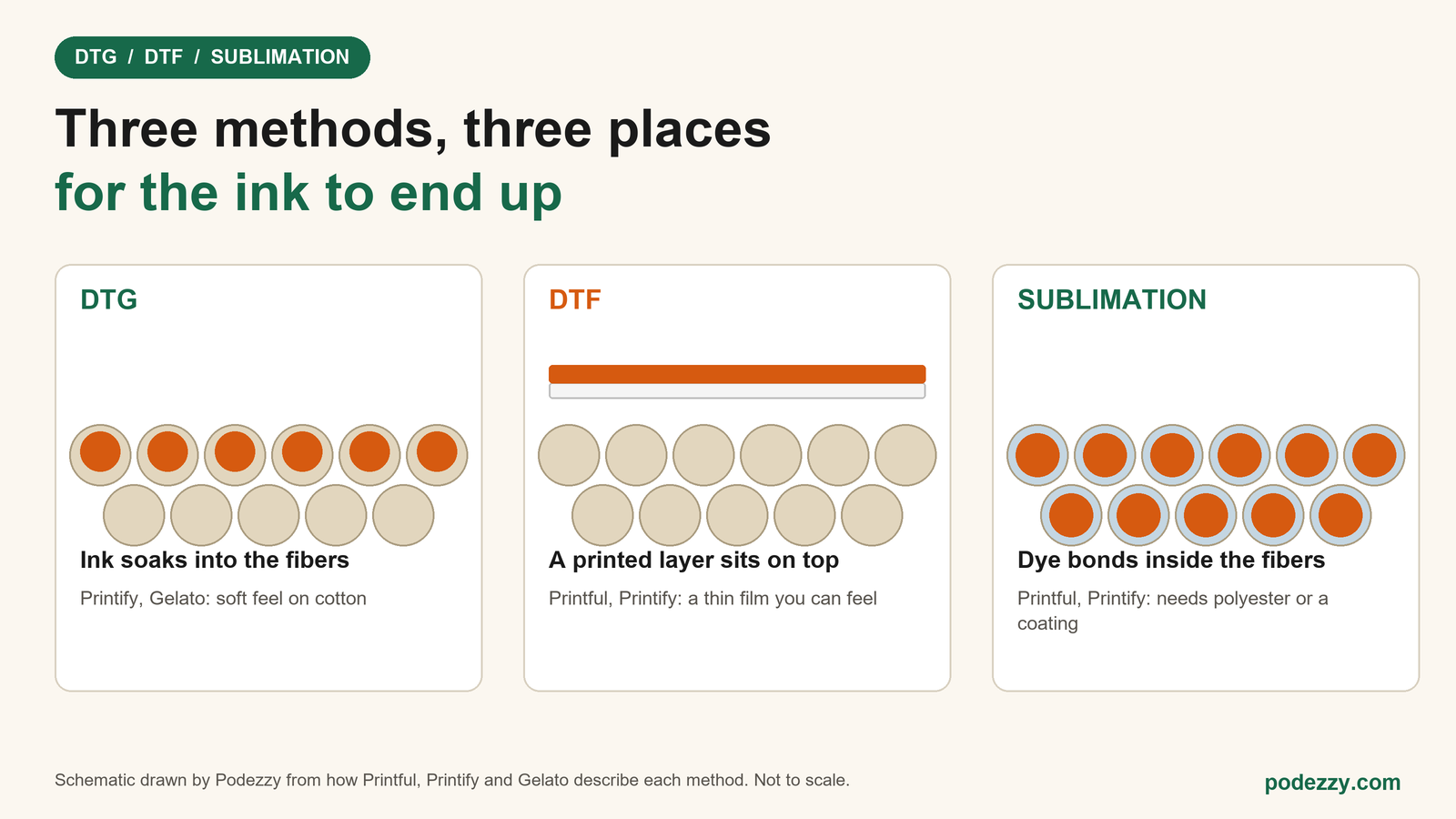
The print method follows the product. Printful and Printify point 100% cotton tees to DTG, and blends and polyester to DTF. Dark blanks take DTF, or DTG with a white underbase. Both also point white or light polyester and mugs to sublimation. Stickers use none of the three: Printful prints them digitally on paper.
Gelato's pages do not agree with each other, and this post says where. Each provider claim names the page it comes from, read on November 23, 2026. Podezzy is a free toolkit for Etsy print-on-demand sellers. It adds its own sorting of Printful's public catalog API for the six blanks we cover (Gildan 5000, 64000, 18000, 18500, Bella+Canvas 3001 and Comfort Colors 1717), plus runs of its Print File Checker on test files.
Which print method suits which Etsy POD product?
Start with the fiber and the color of the blank, then confirm the method on your provider's product page, because one blank can be printed two ways. Which methods you can sell also depends on which print provider you choose. A cell records what that provider's pages recommend, and the provider may offer the other methods too.
| Product | Printful | Printify | Gelato |
|---|---|---|---|
| 100% cotton tee | DTG, DTF also offered | DTG for a cotton line | DTG in 2025 pages, DTF in 2026 |
| Blends and heathers | DTF; DTG less vibrant | DTF for blends | Heathers print less opaque |
| 100% polyester shirt | DTF, or sublimation if light | DTF; sublimation if light | DTF |
| Black or dark tee | DTG with underbase, or DTF | DTF, or DTG with underbase | DTF has a white base built in |
| Mug | Sublimation | Sublimation | Sublimation (2025 blog) |
| Sticker | Digital print on paper | Stickers not named; paper products printed digitally | No page read |
Gelato is the provider that splits. Its DTG vs DTF post (October 1, 2025) says DTG "comes out on top nearly every time". Its DTF guide (May 11, 2026) calls DTF "Gelato's primary method for full-color apparel". Its help center (October 30, 2025) says its primary process is DTG and that it does not offer sublimation or screen printing on textiles. Check the date on any Gelato page.
On blends, all three providers say DTG comes out weaker than on 100% cotton, in different words. Printful says DTG works on cotton blends but does not give the same vibrancy as 100% cotton, and lists cotton, polyester, fleece, nylon and blends for DTF. Printify's design guide says DTG on blended fabric looks less crisp than on 100% cotton, and its DTF post says to choose DTF for blends or darker blanks. Gelato's help center advises at least 80% cotton on sweatshirts and hoodies for the brightest prints, and says heather colors, which hold 10% to almost 50% polyester, print less opaque than solids.
Bella+Canvas, which makes the 3001, says in its printing FAQs that not all DTG platforms and inks support fabrics that contain polyester, and tells printers to ask their DTG machine maker. It calls DTF "largely comparable across the BELLA+CANVAS collection". The DTG machine is the provider's choice, so order a sample in the heather color before you list it, as Printify and Gelato both advise.
On 100% polyester, Printify says DTG is not recommended because synthetic fibers repel water-based ink, and Printful calls purely synthetic fabrics a poor fit for DTG. Both point to DTF, and to sublimation when the blank is white or light. Gelato's May 2026 guide says DTG "can't reliably print" polyester, nylon or performance fabrics.
Blank makers say little. Gildan's retail page for the 5000 (saved November 13, 2026) lists screen printing, embroidery, iron-on transfers, bleaching and tie dye as decorating techniques and does not list DTG, while its 64000 page does. Printful and Printify both offer DTG on the 5000.
On mugs, Printful's White Glossy Mug page lists the technique as "Mug sublimation", and its catalog API tags all six of its mugs as sublimation. Printify's decoration methods page lists mugs under all-over printing or sublimation. Gelato's DTF or sublimation post (October 8, 2025) names full-wrap mugs and coasters as sublimation products.
On stickers, Printful's API tags its five sticker and decal products as "Digital printing", and its Kiss-Cut Sticker Sheet page says the design is printed on paper. Printify's page says paper products use digital printers but does not name stickers.
What does the buyer get from each method?
On feel, the providers describe DTG as soft, DTF as a firmer thin layer and sublimation as no feel at all. Printify says DTG feels softer than DTF because the ink soaks into the fibers, while DTF is a thin smooth layer that feels firmer until it softens over the first few washes. Gelato calls DTG's feel soft and lightweight. Printful says DTF may feel stiff at first and softens after a couple of washes. Printful, Printify and Gelato all say sublimation leaves no feel at all, because the dye sits inside the fiber.
All three providers warn about large DTF prints. Printful does not recommend DTF for large, full-coverage designs. Printify says the firmness is more noticeable in a large solid design. Gelato's October 2025 post says large designs can look stiff across the chest and back.
Wash life is where the numbers stop being comparable. The pages read do not say how most of them were measured.
| Provider page | Method | What it says |
|---|---|---|
| Printful DTG page | DTG | Holds color through 100 wash cycles in Kornit's 2026 test |
| Printful DTF vs sublimation (Sep 23, 2026) | DTF | Multiple washes without significant fading; minor cracks if washed hot |
| Printify DTF vs DTG (Oct 1, 2026) | DTG, DTF | DTG past 50 washes, fades slowly; DTF 50 to 100, can crack or peel |
| Printify DTF vs sublimation (Sep 25, 2026) | DTF, sublimation | DTF 30 to 50 cycles; sublimation hundreds of washes |
| Gelato DTF or sublimation (Oct 8, 2025) | DTF, sublimation | DTF 50+ washes; sublimation lasts as long as the garment |
| Gelato DTG vs DTF (Oct 1, 2025) | DTG, DTF | DTF more prone to cracking or fading than DTG |
Printify gives two different DTF figures in posts published six days apart: 50 to 100 washes and 30 to 50 cycles. Only Printful's DTG page names a test, and it is Kornit's, the maker of the printers Printful says it uses. Treat each number as the provider's claim, and wash a sample yourself.
Dark shirts treat the three methods differently. Printful says DTG puts a white ink underbase on dark garments and skips it on light ones. Printify's design guide says every DTG garment except white gets an underbase, and Gelato says it prints no white ink on white or natural garments. Each provider has its own idea of "light", so ask. DTF prints a white base under the colors every time, according to Printify and Gelato. Printful says sublimation ink is translucent and leaves only a faint trace on dark colors, and Gelato's DTF or sublimation post says sublimation "can't show up on dark materials".
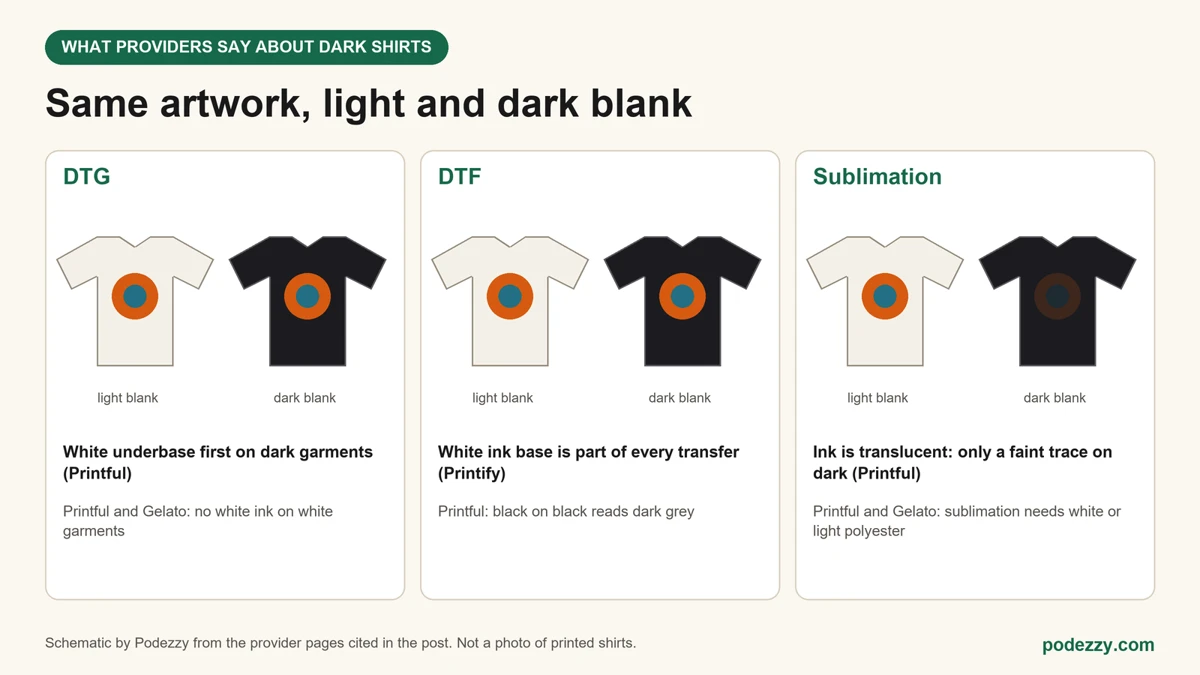
Black ink on a black shirt looks weak in DTG and DTF alike. Printful says black prints grey on black garments over the white underbase, and Gelato says the white layer under black ink makes the print look lighter or glossier than the fabric. Both tell you to leave those areas transparent so the shirt shows through. Printful also says a black DTFlex design on black fabric looks paler or greyer.
Which methods does Printful offer on the blanks Podezzy covers?
Printful's public catalog API lists DTG, DTF and embroidery on all six blanks we cover, and sublimation on none. Podezzy pulled the techniques field for each product on November 23, 2026. Printful's pages call its DTF "DTFlex"; the API says "DTF printing".
| Blank | Fiber, per Printful | DTG | DTF | Sublimation |
|---|---|---|---|---|
| Gildan 5000 | 100% cotton; heathers 50/50 | Yes (default) | Yes | No |
| Gildan 64000 | 100% ring-spun cotton; heathers 65% polyester | Yes (default) | Yes | No |
| Gildan 18000 | 50% cotton, 50% polyester | Yes (default) | Yes | No |
| Gildan 18500 | 50% cotton, 50% polyester | Yes (default) | Yes | No |
| Bella+Canvas 3001 | 100% cotton; heathers contain polyester | Yes (default) | Yes | No |
| Comfort Colors 1717 | 100% ring-spun cotton, garment-dyed | Yes (default) | Yes | No |
Printful sets DTG as the default on all six. The two 50/50 blanks are where the blend advice matters, because Printful's own article says DTG on blends will not match 100% cotton for vibrancy.
Our sorting of the whole catalog, which is Podezzy's count and not Printful's: the API returned 586 products. Of those, 165 list DTG and 154 list DTF. 71 list both, 94 list DTG only and 83 list DTF only. 74 products list sublimation, and none of them also lists DTG or DTF. Six of the 74 are mugs. Printful's API tags its all-over print products as "All-over synthetic" (115 products) or "All-over cotton" (22), not as sublimation, so we did not count those.
Printify's catalog pages for the Gildan 5000, Bella+Canvas 3001 and Gildan 18500 list DTG, puff print, embroidery, glitter print and metallic print as decoration methods. DTF is not a listed method, although the 5000 and 3001 pages say some providers print sleeves and neck labels with DTF. The same Gildan 5000 can therefore be DTG, or DTG with DTF sleeves, depending on the provider you pick.
What does each method need from the print file?
Printful asks for at least 150 DPI on DTG and DTF garments, 300 DPI on mugs, and 300 DPI plus 0.25 in between cut objects on its sticker sheet. Gelato asks for 300 DPI on DTF. The providers' numbers differ, so build the file to the strictest page you sell through.
| Method | Printful | Printify | Gelato |
|---|---|---|---|
| DTG | PNG or JPEG, 150 DPI or higher, sRGB | No DPI figure in the guide | Minimum 150 DPI, advises 300, sRGB |
| DTF | 150 to 300 DPI, sRGB (May 2024 guide) | No DPI figure in the guide | 300 DPI minimum, transparent PNG |
| Sublimation, mug | At least 300 DPI, sRGB | Avoid small details | No page read |
| Sticker sheet | 300 DPI, 0.25 in between cut objects | No page read | No page read |
Printify's design guide says its Product Creator shows each product's requirements and the resolution of your upload. Gelato's DTG file guidelines set the 150 DPI floor and then advise 300. Podezzy's DPI guide treats 150 DPI as the floor for garments, which matches Printful's 150 DPI and not Gelato's advice of 300.
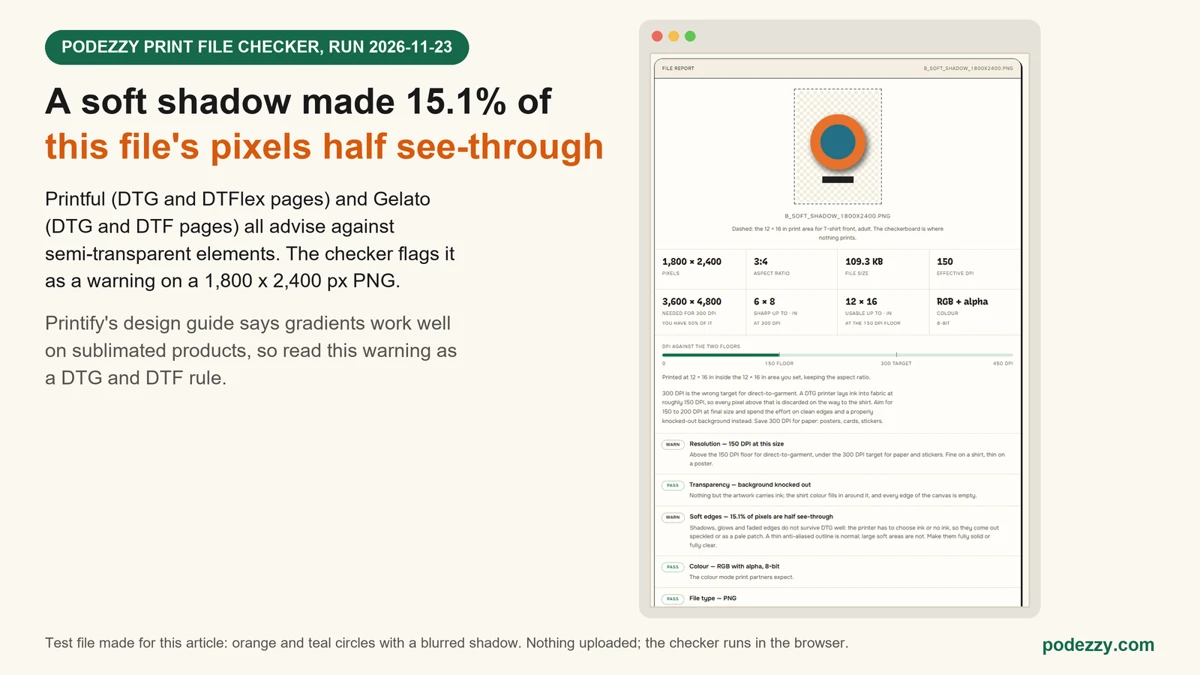
Several rules repeat across providers. Printful (DTG and DTFlex) and Gelato (DTG and DTF) advise against semi-transparent elements, and Printful suggests halftones for the effect. Printful and Gelato print no white ink on white garments, so white artwork disappears on a white tee. Printful's DTFlex guide adds three more: no small dots or narrow lines, which can peel; no soft edges; no gradients that fade to transparent. Printify's design guide says the opposite for sublimation, that gradients work well.
Sublimation has its own rules. Printful says any white or blank area in the file prints as the color of the product. Remove white borders, fill the template to the edge, and use a transparent background only for a partial design. Printify warns that a mug's seam line can show even with a full-bleed design.
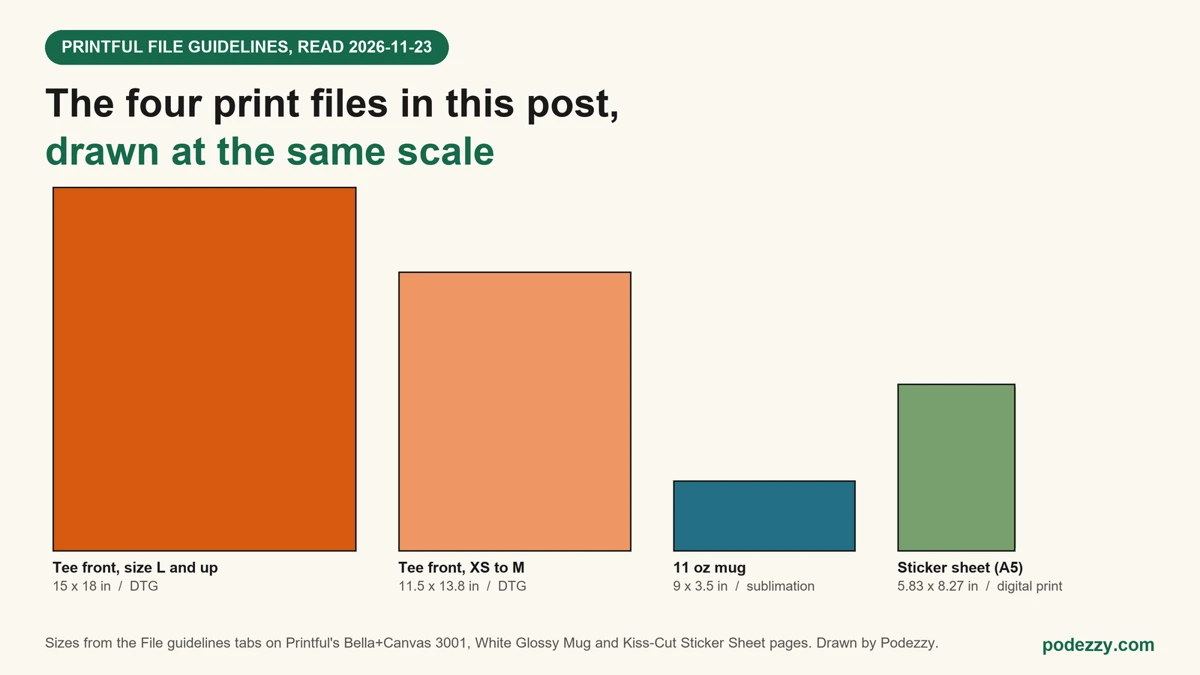
The pixel sizes follow from Printful's own file guidelines. We typed each size into Podezzy's Design Size Calculator, which converts a size in centimeters or inches into pixels at 150 or 300 DPI.
| Printful file | Template size | Pixels at 150 DPI | Pixels at 300 DPI |
|---|---|---|---|
| 3001 front, XS to M (DTG) | 29.21 × 35.05 cm | 1,725 × 2,070 | 3,450 × 4,140 |
| 3001 front, L and up (DTG) | 38.10 × 45.72 cm | 2,250 × 2,700 | 4,500 × 5,400 |
| 11 oz mug (sublimation) | 22.86 × 8.89 cm | 1,350 × 525 | 2,700 × 1,050 |
| Kiss-Cut Sticker Sheet | 5.83 × 8.27 in | 875 × 1,241 | 1,749 × 2,481 |
The calculator's mug preset is 8.5 × 3.5 inches, while Printful's 11 oz template is 22.86 × 8.89 cm, which is 9 × 3.5 inches, so type Printful's size as a custom size. Podezzy's size guide says the usual adult front is 12 × 16 inches; Printful's 3001 template is smaller up to size M and larger from size L.
To check your own file, open Podezzy's Print File Checker, pick the product preset, or type your provider's template size as a custom size, and drop in the PNG. It reports the DPI at that size, transparency, color mode and file type, and the file stays in your browser. Podezzy ran it on nine test files made for this post on November 23, 2026; seven are in the table.
| Test file | Preset | DPI | What the checker said |
|---|---|---|---|
| 1,800 × 2,400 PNG, clear background | Tee front 12 × 16 in | 150 | Pass on transparency; warns that 150 is under the 300 target for paper |
| Same art with a soft shadow | Tee front | 150 | Extra warning: 15.1% of pixels half see-through |
| Same art flattened on white, JPEG | Tee front | 150 | Warns: no transparency, and a JPEG for fabric |
| Same art, CMYK JPEG | Tee front | 150 | Adds a CMYK warning; asks for sRGB |
| 900 × 1,200 PNG | Tee front | 75 | Fail: under the 150 floor |
| 1,350 × 525 PNG (a 2,700 × 1,050 file passes) | Custom 9 × 3.5 in | 150 | Warning only, though Printful asks 300 for a mug |
| 450 × 450 PNG (a 900 × 900 file passes) | Sticker 3 × 3 in | 150 | Warning only, though Printful asks 300 for stickers |
The checker has no print-method setting. It applied the same 150 DPI floor to every preset we tried (tee front, sticker and a custom mug size). Its soft-edge warning is a DTG and DTF rule, so ignore it for a sublimated mug wrap. Its note that 300 DPI is the wrong target for DTG is Podezzy's position, and Gelato's pages advise 300.
DTG, DTF and sublimation FAQ
Is DTF better than DTG for Etsy sellers?
Neither wins on every product. Printify says neither is inherently better: choose DTG for a cotton line and DTF for blends or darker blanks. Gelato's two pages disagree, so read the date.
Can you use sublimation on a cotton t-shirt?
No, according to Printful, Printify and Gelato. They say the dye needs polyester fibers or a polymer coating, and Printful adds that on cotton the dye washes out quickly.
Which method works on a black t-shirt?
DTG with a white underbase and DTF both print on black, according to Printful and Printify. Sublimation does not, because its ink is translucent.
Does a DTF print crack or peel?
Printful says washing in hot water can cause minor cracks. Printify says the surface layer can crack or peel in high-flex areas, and Gelato says a stiff print usually points to a lower-quality production process. All three give cold or lukewarm washing as the care rule.
What DPI should I use for DTG, DTF and sublimation?
Printful asks for 150 DPI or more on DTG, 150 to 300 on DTF and 300 on mugs. Gelato asks for 300 on DTF and advises 300 on DTG. Printify's guide gives no figure, so use the requirements its Product Creator shows.